




For decades, technology has always been changing. One such example is how USB-C rechargeable lithium-ion batteries replaced disposable alkaline batteries. However, it took more than just advancements in battery technology. A technology that is getting close to thirty years old may sound strange.
But the Universal Serial Bus (USB) has evolved into a crucial component of modern technology throughout time. Additionally, the technology has undergone numerous improvements. With USB adapters, we have advanced significantly and here is all you need to know.
About USB
USB or Universal Serial Bus is a circuit link used to move power or data between parts of an electronic system. A “serial” bus uses a single cable to send data one bit at a time. The USB technical standard sets the specifications for the connectors and cables used to connect the different devices in an electronic system.
The best part is that users don’t have to worry about changing any device settings. They may simply “plug and play” because the USB interface doesn’t require user configuration. To put it simply, the USB standard makes it simple to connect and communicate data between devices. However, with advancements, it is now capable of much more.
The Evolution of USB Adapters
Isn’t it great to bring only one connector cable with you when you travel? Wondering if it is even possible? Well, yes, thanks to USB adapters, as they are a true game changer. They are also frequently kept on hand in homes and offices.
Since its debut, it has been the industry standard for data and power transfer between devices. It has eliminated the issue of connection complexity and slow data transfer present in early 1990s computer systems. How did it all happen? Here is a detailed guide to everything:
1. USB 1.0
USB 1.0 was first intended to transfer data between a computer and a peripheral. It was ideal for devices like printers and external drives. At the low end, it was rated at 1.5 Mbit/s, and at the high end, at 12 Mbit/s. Although it wasn’t much, it was a beginning. 1996 saw the debut of USB 1.0. But the first USB devices weren’t made available until 1998.
However, in reality, these were USB 1.1 devices. Connection instantly changed with the release of USB 1.0. With initial speeds of 1.5 megabits per second (Mbps), it eliminated the need for serial and parallel ports. It also eliminated the need for the cards and drivers associated with them. As a result, it also enabled far faster data connections.
2. USB 2.0
The second generation of USB technology saw a significant change. This was brought on by the release of USB 2.0. It was created with a battery charging specification in mind, in addition to data transmission. When it debuted in 2000, it merely delivered data.
USB 2.0 introduced the concept of utilising USB to power devices. In relation to data transfer, USB 2.0 increased the technology’s top speed to 480 Mbit/s. This also eliminated the need to use bulky USB adapters for different devices.
3. USB 3.0
About eight years later, USB 3.0 was made available. It quickly became the standard that most of us are familiar with. It gained huge popularity since it provided even quicker speeds. Additionally, it provided some degree of backward compatibility with devices that used an earlier USB specification.
With regard to cables, this third generation saw some further improvement. It was a massive leap with a data transfer speed of 5 Gbps. Compared to USB 2.0, it was made 10 times faster, ensuring quicker transfers of files and videos. Additionally, it also ensures faster charging.
4. USB-C
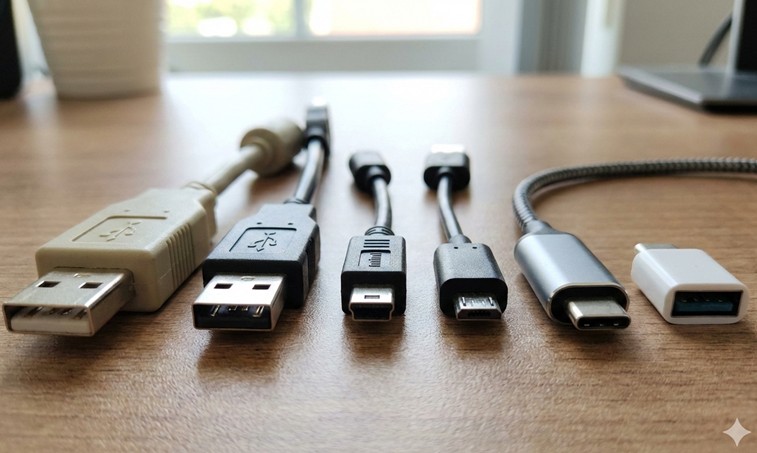
On the back of USB 3.1, USB-C was created, which included a new cable and connector. It was meant to take the place of every connector that came before it. Being concentric, the new connector has no top or bottom. The new standard substitutes a single replacement that works with any compatible device for proprietary cables and connectors.
The evolution of this USB adapter offers faster data transfer of up to 10 Gbps+. For rechargeable lithium-ion batteries, users have decided to use USB-C standards. Fortunately, even though USB 4.0 was released in 2019, the industry has approved the new cable and connector for USB-C. The cable and connector are likely to last for some time.
Impact of the Continuing Relevance of USB
Before the development of USB, computer users had to rely on a variety of port configurations. This includes serial, parallel, or game ports to create a connection between devices. The development of USB allowed for the replacement of these various interfaces with a single connector. It has now become the standard for the majority of electronic devices.
Growth of USB adapters removed the hornet’s nest of connectors and cables. It made increased data rates and power delivery via a compact, affordable, and user-friendly interface possible. What started as a means of connecting peripherals evolved into a means of enhancing the user experience with a wide range of products.
This includes games, toys, smart home appliances, smartphones and other mobile devices, and industrial networking. These days, USB devices are also widely used just for charging. Because of these characteristics, USB is currently the most widely used signal transfer technology worldwide. Given its huge benefits, its uses will only increase.
Connect Anywhere, Anytime With Endless Possibilities
From USB 1.0 to USB-C, USB adapters have gone through several changes. Each time, it came out as a better version, offering a plethora of benefits to its users. For instance, the most recent version of the USB connector, USB Type-C, will simplify hardware compatibility between devices.
Users can also enjoy a dependable way to connect peripheral devices to the computer. In addition to these useful advantages, USB Type-C connectors are easier to use because of their reversible design. So, whether you are tech-savvy or not, the seamless experience is all yours.